Print > Setting the Machine (PS/PCL/UFR II Printer) > Printing Directly from the Remote UI > Printing XPS Files Directly
*
Printing XPS Files Directly

Return to Overview


Follow the steps below for Direct Printing of a XPS file from the Remote UI.


Remark
  • This XPS File menu is only available for the PS Printer or XPS Direct Print Printer.

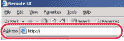
  1. Start your web browser → enter the appropriate URL into [Address] or [Location].

http://<the IP address of the device>/

  • If you do not know the appropriate URL, consult your system administrator.
  • When the printer's host name is registered on the DNS server, you can enter it in place of the IP address in [Host Name/Domain Name].
    Example : http://my_printer.xy_dept.company.com
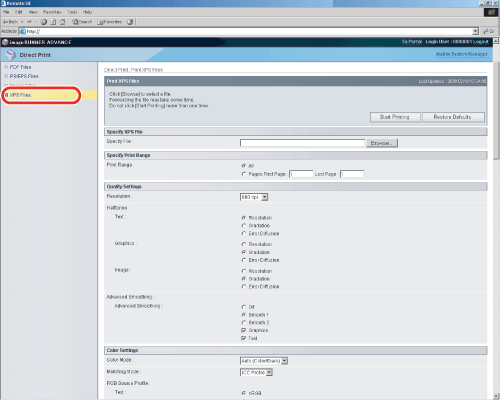
  1. Click [Direct Print] → select [XPS File] from the menu that appears under [Direct Print].

If Department ID Management is set, a dialog box prompting you to enter the Department ID and password appears. Enter the Department ID and password → click [OK].

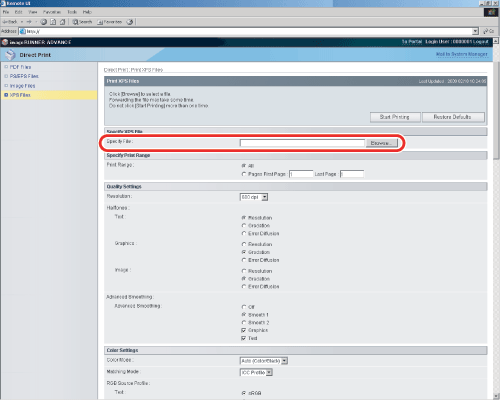
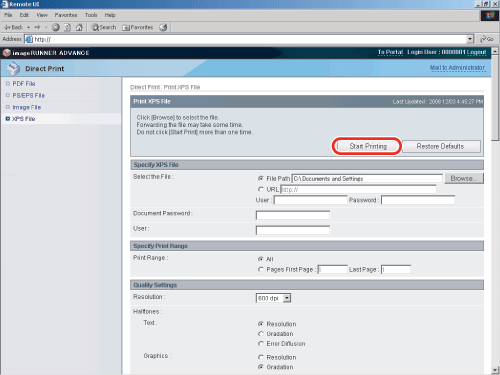
  1. Specify the location of the XPS file that you want to print.

Click [Browse] → click [Open] after selecting the file.


  1. Specify the settings for [Specify Print Range].

Select [All] to print every page.

If you want to specify the pages to print by the page number, click [Pages] → enter the page numbers. Only the setting for the item whose radio button is selected will be effective.

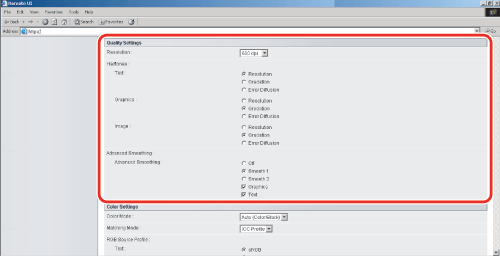
  1. Specify the settings under [Quality Settings] according to your preference.

Details of each menu are shown below.

[Resolution] This setting specifies the resolution for printing.
Resolution is expressed in units of dpi (dots per inch), indicating the number of dots in one inch. The higher the value, the greater the resolution, allowing finer expression of detail.
  • If [600 dpi] is selected, you can perform printing suited to general documents and tables.
  • If [1200 dpi] is selected, characters and lines can be finely printed.
[Halftones] This setting specifies how to express halftones in black and white data.
Print data is expressed in dots. Fine gradations, edges, and shades are expressed by using dither patterns, which are groups of dots. This is called halftone processing.
  • If [Gradation] is selected, you can print with both smooth gradation and outlines, which is best to print graphs and graphics that use gradation.
  • If [Resolution] is selected, you can print text with distinct outlines, which is best to print text and thin lines.
  • If [Error Diffusion] is selected, finer printing can be done than with [Resolution], although toner stability is somewhat weaker. This is suited to printing small characters and fine lines, and outlines (such as from CAD data) sharply.
[Advanced Smoothing] This setting smoothes jagged outlines of graphics (illustrations created by application software) and characters.
  • [Smooth 2] performs a higher level of smoothing than [Smooth 1]. If [Smooth 1] is selected and the results are still not printed smoothly, select [Smooth 2].
  • By switching the on/off for 'Graphics' and 'Text', you can select whether to apply smoothing to graphics or text data.
  • This setting allows you to apply smoothing to graphics data and text data. Smoothing is not applied to image data.
  • The setting for 'Text' is invalid if 'Resolution' is set to [1200 dpi].
  • "Graphics" and "Text" can only be selected when [Smooth 1] or [Smooth 2] is selected for Advanced Smoothing.
  • Settings for "Graphics" and "Text" on the touch panel display will be effective only if 'Printer Default' is set for Advanced Smoothing in the printer driver.
  • The results of Advanced Smoothing may differ depending on the characters and graphics patterns.

  1. Specify the settings under [Color Settings] according to your preference.

[Color Mode] This setting enables you to set the color mode you want to specify when printing.
  • If [Auto-Color Select] or [Full Color] is selected, the machine automatically detects whether the page is reproduced using black (K) only or all four colors: cyan (C), magenta (M), yellow (Y), and black (K).
  • If [Black] is selected, data is printed in black (K) only, even if the original is in color.
[Matching Mode] This setting enables you to set the type of color matching method to apply for each text, graphics, and image that make the print job, or for each color space, such as RGB and CMYK.
  • If [ICC Profile] is selected, you can select the matching method to compensate the difference between the color spaces used for the input profile (applied to the color space used for input data) and the output profile (defines device dependent color space).
  • If [Kyuanos] is selected, you can select the type of the ambient light used on the printed documents in the space displayed on the monitor that matches the printed document.
[Monitor Color Space] This setting enables you to match the prints to the monitor display (sRGB or Adobe RGB).
  • If [sRGB] is selected, color matching is performed to match prints to an sRGB compatible monitor.
  • If [Adobe RGB] is selected, color matching is performed to match prints to an Adobe RGB compatible monitor.
[Environment Light] This setting enables you to specify the high color rendering setting to perform color matching for each print job.
  • If [D50] is selected, ambient light compensation is performed to match high color temperature of 5,000 K.
  • If [D65] is selected, ambient light compensation is performed to match high color temperature of 6,500 K.
[RGB Source Profile] This setting allows you to specify the RGB profile (color data represented using the RGB (Red Green Blue) color model) that is appropriate for the characteristics of your monitor. This setting is applied when printing a document containing color images or graphics made by the RGB color model.
  • [sRGB]
    This setting specifies the industry standard definition for generic Windows computer monitors. If you are using an sRGB compatible monitor, you can print out colors close to how they appear on your monitor.
  • [Gamma 1.5, Gamma 1.8, and Gamma 2.4]
    These settings enable you to select the gamma correct level of the RGB data. The higher the value, the darker the printout.
  • [None]
    When this setting is selected, device dependent RGB data is converted into CMYK without applying the RGB profile.
  • [Download Profile]
    This setting specifies the profiles you have downloaded from the host computer to this machine using imageWARE Enterprise Management Console. You can store up to 100 profiles.
[Output Profile] This setting allows you to define the profile that is appropriate for the data you are going to print. It is applied to all data in the print job, so make sure the selected profile is right for your job.
  • [Normal]
    This setting prints the color closely matching the ones displayed on your monitor.
  • [Photo]
    This setting prints colors close to photographic prints.
  • [Download Profile]
    This setting uses custom simulation target that you have downloaded from the host computer to this machine using imageWARE Enterprise Management Console. You can store up to 100 profiles.
[Matching Method] This setting allows you to specify a method of printing when the RGB Source Profile is applied. This machine includes a color management system that provides the following color rendering styles.
  • [Perceptual]
    This setting produces the best results for photographic or bitmapped images.
  • [Saturation]
    This setting is best suited for printing illustrations and diagrams used in business presentations.
  • [Colorimetric]
    This setting provides a close match to the RGB color value of the machine's printing range.
[Gamma] The brightness of printing can be adjusted to not lose the brightest and darkest portions of the original data. For example, this setting is made when the printout is brighter than the original image (original photograph before being scanned, graphics created on a monitor, etc.) or when wanting to change the brightness before printing. The higher the value, the darker the printout. [1.4] is the value for an uncorrected (default) state.
[Photo Optimizer PRO] You can adjust the contrast, color balance, saturation, and balance for images.
  • If [On] is selected, Photo Optimizer PRO is performed on the image.
  • If [Off] is selected, the machine will not perform Photo Optimizer PRO.
  • This setting is invalid for black-and-white data.
  • If the color mode is set to [Black and White], this setting is invalid.
[Red-Eye Correction] Detects and corrects red-eyes on photographs occurred because of the flash or electronic flash when photographing. You can also make corrections when only half of the face is shown on the photograph. You can specify the settings for each type of data: [Red-Eye Correction] and [Red-Eye Correction Level].
  • If [On] is selected, red-eye correction is performed on the image.
  • If [Off] is selected, red-eye correction is not performed.
  • If [Weak] is selected, correction level is small.
  • If [Standard] is selected, correction level is between 'Weak' and 'Strong'.
  • If [Strong] is selected, correction level is big.
  • This setting is invalid for black-and-white data.
  • If the color mode is set to [Black and White], this setting is invalid.
[Face Brightener] If faces in the photographs appear dark because of backlight or underexposure, you can correct the brightness of the entire image to obtain the desired brightness for faces. You can specify the settings for each type of data: [Face Brightener] and [Face Brightener Level].
  • If [On] is selected, Face Brightener is performed on the image.
  • If [Off] is selected, Face Brightener is not performed.
  • If [Weak] is selected, correction level is small.
  • If [Standard] is selected, correction level is between 'Weak' and 'Strong'.
  • If [Strong] is selected, correction level is big.
  • This setting is invalid for black-and-white data.
  • If the color mode is set to [Black and White], this setting is invalid.
[Grayscale Conversion] You can select ways to convert color values to a grayscale value when you print color print data.
  • [sRGB]
    lets you to calculate the grayscale value by the color conversion method based on sRGB.
  • [NTSC]
    lets you to calculate the grayscale value by the color conversion method based on NTSC.
  • [Uniform RGB]
    counts the average value of the Red, Green, and Blue values as the grayscale value.
  • This section describes the settings to convert the color data into grayscale data.
  • This setting is invalid for black-and-white data.
  • If the color mode is set to [Auto Detect] or [Full Color], this setting is invalid.
[Perform Gray Compensation] This setting determines whether only black (K) toner is used. If you enable this option, black and gray data is printed using the black (K) toner only, which lessens toner bleeding.

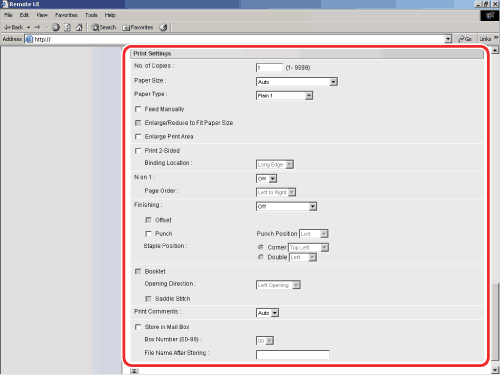
  1. Specify the settings under [Print Settings] according to your preference.

Details of each menu are shown below.

[No. of Copies] This setting enables you to specify the number of copies printed.
[Paper Size] This setting specifies the output paper size.
  • If [Auto] is selected, the most appropriate paper source is selected according to the XPS file page size.
  • If a setting other than [Auto] is selected, the file is printed so that the orientation of the long edge of the XPS file page size and the long edge of the selected paper matches.
If the paper size is set to [Auto], the default paper size is used to print data for which the paper size is larger than the maximum or smaller than the minimum available for the machine.
[Paper Type] This setting specifies the output paper type.
[Feed Manually] This setting enables you to fix the paper feed source to manual feed.
[Enlarge/Reduce to Fit Paper Size] If you select the checkbox, the selected page size is enlarged or reduced with the same ratio for both the length and width to print within the printable area. However this function is not available if [Auto] is selected in [Paper Size].
[Enlarge Print Area] This setting specifies whether to enlarge the printable area to the edge of the paper.
[Print 2-Sided] This setting specifies whether to print on one-side or both sides of the paper.
[Binding Location] This setting specifies whether to place the binding position along the long edge or the short edge of the paper. If the margin is specified on the touch panel display, the binding margin position is automatically adjusted on the front and back sides of the paper.
For more information, see "Gutter."
[Page Order] If you print multiple pages on one page in the [Page Layout] settings, you can specify the order that the pages are arranged onto the source paper.
[Finishing]* This setting specifies whether to print in pages or copies.
  • If [Off] is selected, all copies of the same page are printed before the next page is printed.
  • If [Collate (Page order)] is selected, all pages of each copy are printed before the next copy is printed.
  • If [Group (Same pages)] is selected, all copies of the same page are printed before the next page is printed.
  • If [Staple+Collate] is selected, all pages of each copy (collating) are printed and stapled.
[Offset]*
  • If the checkbox and [Collate (Page order)] are selected in [Finishing], all pages of each copy (collating) are printed, and every other complete copy is offset to indicate where each copy starts.
  • If the checkbox and [Group (Same pages)] are selected in [Finishing], all copies of the same page are printed before printing the next page. Every other complete set of pages is offset to indicate where each new set starts.
[Punch]* This setting allows you to punch holes in the printed-paper.
Select the checkbox and one of either [Left], [Right], [Top], or [Bottom].
If you select both the staple and punch settings, specify the punch and staple settings so the positions match. If the positions do not match (for example, the staple position is on the right and the punch position is on the left), both settings are void and the paper is printed without either stapling or punching. The number of holes that can be punched varies depending on the type of puncher unit of the attached finisher.
[Staple Position]* This setting specifies the staple position if [Staple+Collate] is selected in [Finishing].
  • If [Corner] is selected, you can select one of either [Top Left], [Top Right], [Bottom Left], or [Bottom Right].
  • If [Double] is selected, you can select one of either [Left], [Right], [Top], or [Bottom].
[Booklet]* This setting enables you to prepare the printout for binding as a booklet. Booklet printing is a process whereby two pages of data are printed on the front and back of one page and it is folded in half to create a book.
[Store in Mail Box] To store the data in a mail box, select [Store in Mail Box] and then select the destination mail box.
[File Name After Storing] To store the data in a mail box, you can specify the file name.
The file name cannot exceed 24 characters.
* The settings and settings values displayed on the Remote UI differ depending on which options are attached.
  1. Click [Start Printing].

Click [Restore Defaults] to return the settings to their default values.

Do not click [Start Printing] continuously during file transfer. The file transfer process may take some time, but continuously clicking [Start Printing] may cause the file to crash and not transfer.

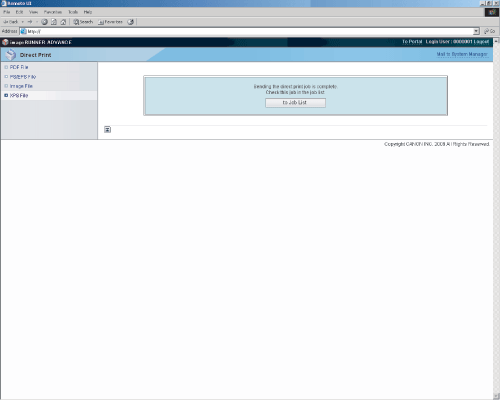
After sending of a print job is completed, the screen changes and the following message appears.

Click [to Job List] to verify sent print jobs that have already been sent.


  • Back To Top